Author:

Yuliia Didenko
When parents seek psychological support for their child, who experiences difficulties, they often expect the specialist to work only with the child and that things will improve. However, in many cases, effective work with a child is impossible without counseling the parents as well. It is adults who shape the atmosphere of safety (or, conversely, anxiety) within the family where a child grows up.
Olena Trehub and Olha Bihun, psychologists at the Voices of Children Foundation, explain how parents’ emotional states affect children, why child therapy may be ineffective without stabilizing adults, and how a family-based approach helps families recover after difficult experiences.
Olena Trehub and Olha Bihun, psychologists at the Voices of Children Foundation, explain how parents’ emotional states affect children, why child therapy may be ineffective without stabilizing adults, and how a family-based approach helps families recover after difficult experiences.
This material was produced within the EMPOWER project (K-UKR-2025-4026) with the support of the German humanitarian organization Diakonie Katastrophenhilfe.
How Parents’ Emotional State Affects a Child’s Behavior
A child grows up within a family system with emotional, social, and psychological dimensions. Parents are the primary source of safety for a child, and it is through them that a child learns how to understand the world: whether it is safe, whether it can be trusted, and how to respond to its challenges.
A child’s nervous system matures gradually, and in the first years of life, it literally “borrows” regulation from an adult. Behavioral changes such as aggression, withdrawal, or conflict often reflect tension within the family. If a mother is anxious, the child becomes restless. If there is conflict between parents, the child may become aggressive or, conversely, overly quiet, trying “not to make things worse.” Psychologists at the Foundation encounter such situations regularly in their practice.
A child’s nervous system matures gradually, and in the first years of life, it literally “borrows” regulation from an adult. Behavioral changes such as aggression, withdrawal, or conflict often reflect tension within the family. If a mother is anxious, the child becomes restless. If there is conflict between parents, the child may become aggressive or, conversely, overly quiet, trying “not to make things worse.” Psychologists at the Foundation encounter such situations regularly in their practice.
A child is brought in with aggressive behavior. You talk to the mother and ask, ‘How are you?’—and she breaks down in tears. ‘I’m confused and exhausted because I don’t know what to do.’ During shelling, the mother feels intense fear and wants to protect her child, but she herself is overwhelmed by fear and anxiety and loses her sense of inner support,
A child may not fully understand what is happening, but they are extremely sensitive to the emotional state of those close to them. Even when parents try to hide their feelings, their bodies and behavior still reveal their true state.
Children’s symptoms are not ‘the child’s problem.’ They are a way of adapting to what is happening around them. A child picks up tension in the body, changes in tone of voice, unstable reactions, and a lack of emotional resources for connection. All of this creates a sense of danger,
Why Child Therapy Does Not Work Without Parental Involvement
Working only with a child, without considering the parents’ condition, often has a limited or temporary effect. Child therapy without parental involvement is especially ineffective when adults themselves are in crisis, experiencing exhaustion, chronic anxiety, depression, or unresolved grief after loss.
In such circumstances, the child is essentially carrying the tension of the entire system. I have seen many cases where a child does well in therapy, but at home the symptoms return because the environment does not change,
Often, the children’s symptoms are a way of saying, “I don’t feel safe right now,” or “I need connection.” Olena Trehub shares a case from her practice: a nine-year-old girl came to therapy because of frequent emotional outbursts and aggression. Working with the mother in parallel revealed that the woman was living in constant anxiety caused by the war, the loss of her home, financial instability, and fear of the future.
When the mother began working on her own emotional state, the child’s aggressive behavior and tantrums gradually decreased, and her psycho-emotional state improved,
Common Mistakes Parents Make When Interacting with Children
- Invalidating a child’s feelings. Parents may say: “Don’t cry, it’s nothing,” “There’s nothing to be afraid of,” “Others have been through worse,” “You’re exaggerating.” These phrases may seem calming to adults, but in fact, they send the message that your feelings are wrong, unimportant, and insignificant. The child does not learn how to cope with emotions. Instead, they suppress, deny, and feel ashamed of them. They may begin to think that something is wrong with them, rather than with the situation, and feel alone in their experiences. A better response would be: “I see that you’re scared/sad/having a hard time right now. Let’s try to figure out together how I can help you.”
- Excessive control. Living under constant control prevents a child from developing independence and their own sense of safety. They live in ongoing anxiety due to constant checks, prohibitions, and restrictions: “Don’t go outside,” “Don’t talk to that friend,” “Call me every fifteen minutes.” Parents act out of love and fear for the child, but such overprotection is not beneficial.
- Emotional withdrawal. Parents may be so absorbed in their own stress, survival, and worries that they are physically present but mentally elsewhere. They don’t ask how the child is doing, fail to notice changes in behavior, and don’t respond to their child’s emotional needs. The child feels abandoned, unwanted, and unfairly guilty for needing attention.
- Expecting adult-level resilience from a child. Especially in crisis situations: “You’re grown up now, don’t be afraid,” “Be strong,” “Don’t cry.” Or when parents place adult responsibilities on the child, such as caring for younger siblings, supporting the mother, “not causing any problems.” However, the child’s nervous system is not yet mature; self-regulation mechanisms are still developing. A child cannot and should not endure their experiences the way an adult does. When such expectations are imposed, the child feels guilty for the “weakness,” becomes exhausted, and loses the opportunity to fully live through childhood.
Both extremes—excessive control and emotional disengagement—are attempts by parents to cope with their own anxiety. These patterns usually emerge not because of “bad parenting,” but due to adult exhaustion and an inability to tolerate a child’s emotions when they are barely coping with their own.
What a child needs is balance: a sense that parents are nearby, that they see and hear them, while also allowing space for growth and trusting the child. A child needs permission to be a child. They need permission to be afraid, to cry, and to need support. This is what allows them to grow up gradually, rather than prematurely under pressure of circumstances, losing parts of themselves.
Parental Stabilization: What It Means in Psychology
When adults hear about the need for stabilization, they often interpret it as a requirement to “not show weakness” or “be strong for the child.” They try to suppress their emotions, believing that this is what stability looks like. But stabilization does not mean pretending everything is fine when it is not. Adults need to learn how to cope with emotions in a healthy way.
Stabilization is not about ‘calming down and feeling nothing.’ It is the ability to tolerate your emotions, recognize them, and not transmit them to the child like uncontrolled tension. It is about restoring inner support, even in difficult circumstances,
A stabilized adult may still feel fear, anxiety, or sadness. But they acknowledge these emotions, know how to process them, and understand how to calm themselves and where to seek support. Such a person does not hide from the child that things are difficult. At the same time, they demonstrate: “Yes, this is hard for me, but I’m coping. I know what to do. We are safe.”
The child sees a living example of an adult who can be emotionally honest while staying grounded and in control; who is aware of their emotions and knows how to regulate them. Who can be emotionally present for a child, even when facing difficulties.
The child sees a living example of an adult who can be emotionally honest while staying grounded and in control; who is aware of their emotions and knows how to regulate them. Who can be emotionally present for a child, even when facing difficulties.
When, during consultations, we normalize the emotional states of both the mother and the child, teach them self-regulation techniques, and help find new sources of support and resources, parents become more stable and balanced. A stable adult becomes a safe container for a child’s emotions,
When parents begin working on their own emotional state, the dynamics of child therapy change: the number of regressions, situations where a child returns to previous symptoms after improvement, decreases. The child learns new ways of responding more quickly, and therapeutic effects become integrated into everyday life.
Child therapy becomes deeper and more sustainable. Positive changes are better consolidated in daily life. The child gains the most valuable thing—the feeling that there is an adult nearby who can withstand reality and remain a source of support even in difficult times,
The psychologist highlights a key idea: a child does not need perfect parents. They need parents who are stable enough. The concept of “good enough parenting” is realized when adults do not strive for perfection, but learn to be emotionally available, honest, capable of acknowledging their mistakes, and willing to work on their own emotional state.

Parents’ Internal Resources That Need Support During Wartime
Constant stress, uncertainty, threats to life, loss, and displacement are deeply exhausting. Yet many parents believe that their own emotions are a weakness or a luxury they cannot afford. Psychologists at the Foundation identify several key internal resources that most often require support.
First and foremost is the capacity for recovery and rest. Many parents live in a state of constant tension, not allowing themselves to relax even for a moment. However, chronic tension exhausts the nervous system.
First and foremost is the capacity for recovery and rest. Many parents live in a state of constant tension, not allowing themselves to relax even for a moment. However, chronic tension exhausts the nervous system.
Above all, parents need a sense of safety and permission to experience their own emotions. Many forbid themselves from feeling fear, anger, or helplessness because they believe they must ‘stay strong for the child.’ But suppressed emotions do not disappear. They are passed on to the child,
Another crucial resource is awareness of personal boundaries and what they can influence. During war, many things are beyond our control. So, attempts to control the uncontrollable lead to more profound exhaustion. What is within our control is our response—how we structure our day and how we communicate with our child.
The ability to ask for and accept help is another resource that often needs strengthening. Many parents believe they must cope on their own and that asking for help is a sign of weakness. In reality, the ability to seek and receive support is a sign of maturity and care for oneself and one’s family.
Permission to be “not okay” may be the most important resource in times of crisis. Many parents live under constant pressure to be strong, positive, and energetic. Acknowledging the right to feel tired, afraid, sad, or confused allows emotions to be processed rather than accumulated.
The ability to ask for and accept help is another resource that often needs strengthening. Many parents believe they must cope on their own and that asking for help is a sign of weakness. In reality, the ability to seek and receive support is a sign of maturity and care for oneself and one’s family.
Permission to be “not okay” may be the most important resource in times of crisis. Many parents live under constant pressure to be strong, positive, and energetic. Acknowledging the right to feel tired, afraid, sad, or confused allows emotions to be processed rather than accumulated.
Working with these resources is an investment in one’s own mental health and in the child’s well-being,
Key Advice for Parents from Psychologists at the Voices of Children Foundation
A psychologist’s suggestion to work not only with the child but also with the parents often meets resistance. Foundation psychologists frequently hear: “The problem is with the child. Why do I need a psychologist?” “Does this mean I’m doing something wrong?” or “I don’t have the time or energy.” Many adults were raised in a paradigm where seeing a psychologist was viewed as a sign of mental illness. As a result, the offer to work on one’s own emotional state may feel like an accusation of being a bad parent.
It’s important to gently explain that seeing a psychologist is about care, not blame or admitting parental incompetence. I usually say: ‘You are not bad parents because things are hard. Things are hard because you are living in extremely difficult circumstances,
Olha Bihun adds that psychologists most often work not with what parents are doing wrong, but with how difficult things are for them. We are living in very challenging times, and being a parent right now is an enormous emotional task.
You have the right to support. You do not have to be perfect,
It is important to understand that a family-based approach is not about finding someone to blame. It is about recognizing that a family is a system in which the state of each member affects the others. The Foundation’s psychologists are convinced that the best thing parents can do for their child is to care for their own internal state, alongside the child and in parallel with the child’s therapy. Parents often believe they must choose between caring for themselves or caring for their child. In reality, these two are inseparable.
You are not required to be strong all the time, and certainly not to be perfect. But you can be honest enough with yourself in order not to remain alone with your emotional state. You can also notice changes within yourself in time and care for your own psycho-emotional well-being,
The psychologist uses the metaphor of an airplane oxygen mask: first put the mask on yourself, then on the child. An anxious, emotionally unavailable parent cannot give a child a sense of safety, no matter how hard they try.
There are no perfect parents, because everyone’s idea of perfection is different. What matters is being aware of your inner state, your needs and fears, because they directly affect your child’s emotional well-being,
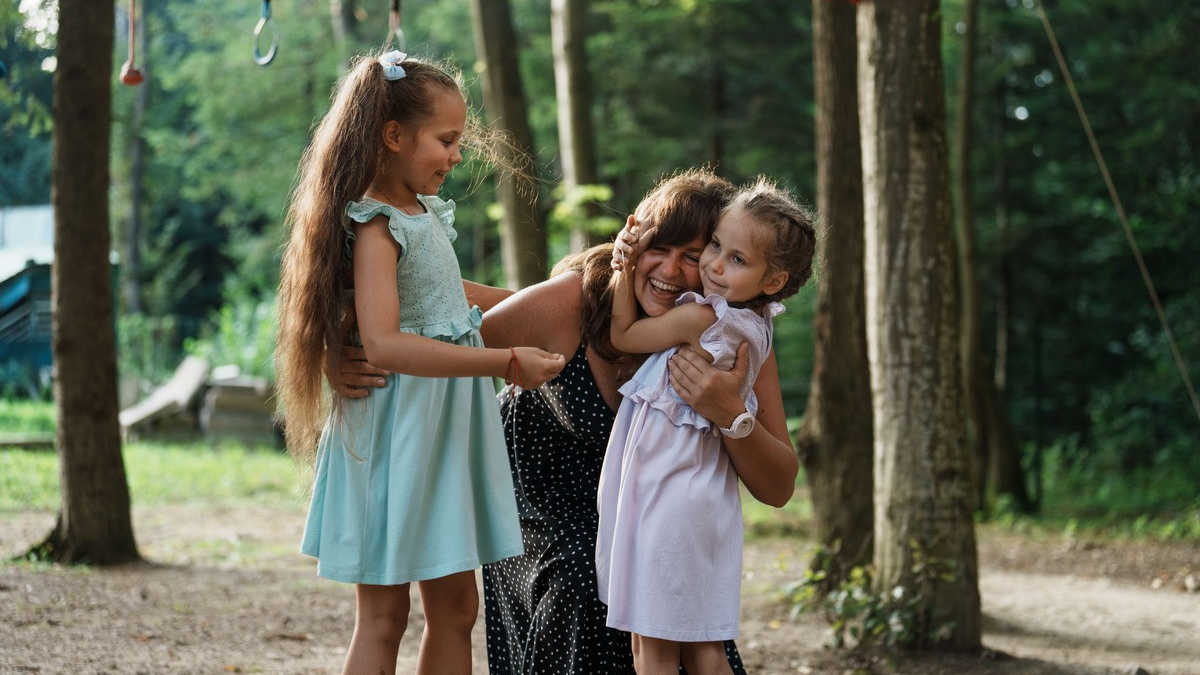
A family-based approach in psychological work helps families rebuild their inner stability together, acknowledge the right to emotions, tiredness, and fear, and allow themselves to be living human beings rather than idealized parents. When parents seek help and work with their emotions, they provide their child with a model of a healthy relationship with oneself—an understanding that caring for mental health is normal and essential.
If you or your child needs support, please contact our centers across Ukraine or our psychological support helpline at 0800 210 106. Currently, ten regional centers of Voices of Children and mobile teams operate across Ukraine. In each center, children can find a supportive community of peers, receive psychological assistance, and take part in creative activities and play.
If you or your child needs support, please contact our centers across Ukraine or our psychological support helpline at 0800 210 106. Currently, ten regional centers of Voices of Children and mobile teams operate across Ukraine. In each center, children can find a supportive community of peers, receive psychological assistance, and take part in creative activities and play.
Share: