Author:

Yuliia Didenko
Nearly 600,000 children living in temporarily occupied territories of Ukraine attend schools that have been fully converted to the Russian education system (according to the Centre for Civic Education “Almenda”). Overall, as of October 2024, around 1.6 million Ukrainian children aged 0–18 remained in temporarily occupied territories.
The Voices of Children Foundation conducted the analytical study “Returning Childhood: Psychological Support for Children on Their Path to Reintegration” to better understand what families face after returning from Russian occupation. We surveyed 45 families and conducted 13 in-depth interviews with parents and caregivers of children who had experienced occupation or deportation. The findings confirm that returning home is often only the beginning of a much longer journey.
The Voices of Children Foundation conducted the analytical study “Returning Childhood: Psychological Support for Children on Their Path to Reintegration” to better understand what families face after returning from Russian occupation. We surveyed 45 families and conducted 13 in-depth interviews with parents and caregivers of children who had experienced occupation or deportation. The findings confirm that returning home is often only the beginning of a much longer journey.
Seven Types of Barriers Families Face After Returning
In the news, returning from occupation or deportation often looks like a happy ending. In reality, families begin an entirely new process of adaptation, facing multiple layers of challenges at once, including institutional, social, psychological, and economic.
Among the seven types of barriers identified in our study, the most significant are:
Taken together, these factors make families even more vulnerable, including to external information influence.
Among the seven types of barriers identified in our study, the most significant are:
- Institutional barriers. Families are often required to repeat the same procedures across different government agencies that operate independently and without a unified protocol for supporting those who have returned.
- Bureaucratic barriers. Administrative procedures add to families’ chronic exhaustion, while short-term programs lasting only one to three months make it impossible to build stable, long-term support.
- A shortage of qualified specialists. Ukraine lacks enough psychologists with expertise in war-related trauma. Those already working in the field often carry excessive caseloads, placing them at high risk of professional burnout.
- Economic barriers. Financial hardship limits families’ access to even basic forms of support. Many struggle to afford psychological consultations, transportation to school, or sometimes even essential everyday necessities.
- Social and psychological barriers. Children and parents face PTSD, disrupted attachment, fear of seeking psychological support because of stigma, and the loss of social connections. Parents who are coping with their own trauma are not always emotionally able to support their children.
- Educational barriers. Years of interrupted education, the lack of trauma-informed approaches, and instances of bullying in schools create conditions that can retraumatize children after they return.
- Cultural barriers. Many psychological approaches have not yet been adapted to the Ukrainian context, while teachers and healthcare professionals often lack sufficient psychoeducational training.
Taken together, these factors make families even more vulnerable, including to external information influence.
Children Returning from Occupied Territories: How the Length of Occupation Affects Their Mental Health
The survey findings and in-depth interviews revealed a clear link between the length of occupation and children’s psychological well-being.
The longer children remain under occupation, the more deeply they are affected by PTSD symptoms and chronic stress. That makes it all the more important that they are not left to cope with these experiences alone once they return.
- The longer children remain under occupation, the more severe the symptoms become. Among children who spent more than three years under occupation, anxiety, aggression, social withdrawal, and loss of interest in activities they once enjoyed were the most common symptoms, affecting 7 to 9 out of 13 children. In the group that spent one to two years under occupation, these symptoms were observed in 4 to 7 out of 8 children, showing levels similar to those in the longest-occupied group. By contrast, children who spent two to three years under occupation appeared to be better adapted, with only 2 to 4 out of 8 children displaying these symptoms. Specialists attribute these differences to factors such as family support, the children’s ages, and the living conditions they experienced while under occupation.
- The length of occupation also affects children’s social skills. More than half of the children who spent over three years under occupation experience difficulties communicating with others and making new friends. Among children who had spent less time under occupation, these challenges were reported half as often. Anxiety and social withdrawal make it harder for children to build new social connections after returning.
- Family remains children’s strongest anchor. Regardless of how long they spent under occupation, parents remain children’s primary source of trust and support. Among those who had lived under occupation for more than three years, 11 out of 13 children said they trusted their parents above anyone else. The longer the occupation lasts, the greater children’s need becomes for continuous reassurance of safety provided by those closest to them.
- Children retain their sense of identity — but talking about Ukraine can be emotionally difficult. Cases in which children became confused about their name or nationality were rare. At the same time, many children experienced emotional discomfort when talking about Ukraine, describing it as “uncomfortable to talk about” or simply avoiding the subject. Children who had spent the longest time under occupation were more willing to share their experiences, possibly because life under occupation had become part of their everyday reality and therefore felt subjectively less traumatic.
- Russian propaganda has not become deeply rooted, but its hidden effects remain visible. They emerge through persistent fears, avoidance of conversations about the war, and a distorted understanding of the context.
The longer children remain under occupation, the more deeply they are affected by PTSD symptoms and chronic stress. That makes it all the more important that they are not left to cope with these experiences alone once they return.
How to Support Children Returning from Russian Occupation: Recommendations for Schools
For children returning from occupation, school is often the first place where they begin learning to trust adults again. That is why recommendations for educators are one of the central sections of the study.
We recommend that schools systematically adopt a trauma-informed approach to help children regain a sense of safety and gradually rebuild trust in adults. In practice, this includes:
Another key recommendation is introducing the role of a school mentor. A mentor is an adult with a background in education or psychology who has been trained to work with children who have experienced trauma. Their role is to provide individual support after a child’s return by:
A mentor complements the work of teachers and school psychologists by recognizing the early signs of anxiety or maladjustment and referring children to specialist support when needed. The Voices of Children Foundation is already piloting this mentoring model in eight schools across Kyiv, the Kyiv region, and the Kirovohrad region to evaluate its effectiveness in real school settings and develop practical materials for scaling the model nationwide.
Supporting educators themselves is another essential priority. Teachers who work every day with children affected by the traumatic experiences of war are at risk of secondary traumatic stress and professional burnout. Regular supervision sessions to discuss challenging cases, training in self-regulation and burnout prevention, as well as art therapy and relaxation activities for teachers help strengthen their professional resilience — and, in turn, ensure consistent support for children.
We recommend that schools systematically adopt a trauma-informed approach to help children regain a sense of safety and gradually rebuild trust in adults. In practice, this includes:
- maintaining a predictable schedule;
- establishing consistent classroom rules;
- creating opening and closing rituals for each lesson;
- setting up safe spaces where children can retreat during moments of stress;
- incorporating brief daily emotional regulation exercises, such as breathing techniques, stretching, or five-minute movement breaks.
Another key recommendation is introducing the role of a school mentor. A mentor is an adult with a background in education or psychology who has been trained to work with children who have experienced trauma. Their role is to provide individual support after a child’s return by:
- helping them adapt to the classroom environment;
- supporting the recovery of learning motivation and social skills;
- facilitating communication between families, teachers, and school administration.
A mentor complements the work of teachers and school psychologists by recognizing the early signs of anxiety or maladjustment and referring children to specialist support when needed. The Voices of Children Foundation is already piloting this mentoring model in eight schools across Kyiv, the Kyiv region, and the Kirovohrad region to evaluate its effectiveness in real school settings and develop practical materials for scaling the model nationwide.
Supporting educators themselves is another essential priority. Teachers who work every day with children affected by the traumatic experiences of war are at risk of secondary traumatic stress and professional burnout. Regular supervision sessions to discuss challenging cases, training in self-regulation and burnout prevention, as well as art therapy and relaxation activities for teachers help strengthen their professional resilience — and, in turn, ensure consistent support for children.
The full set of recommendations for educators, parents, national authorities, and local governments is available in the full report.
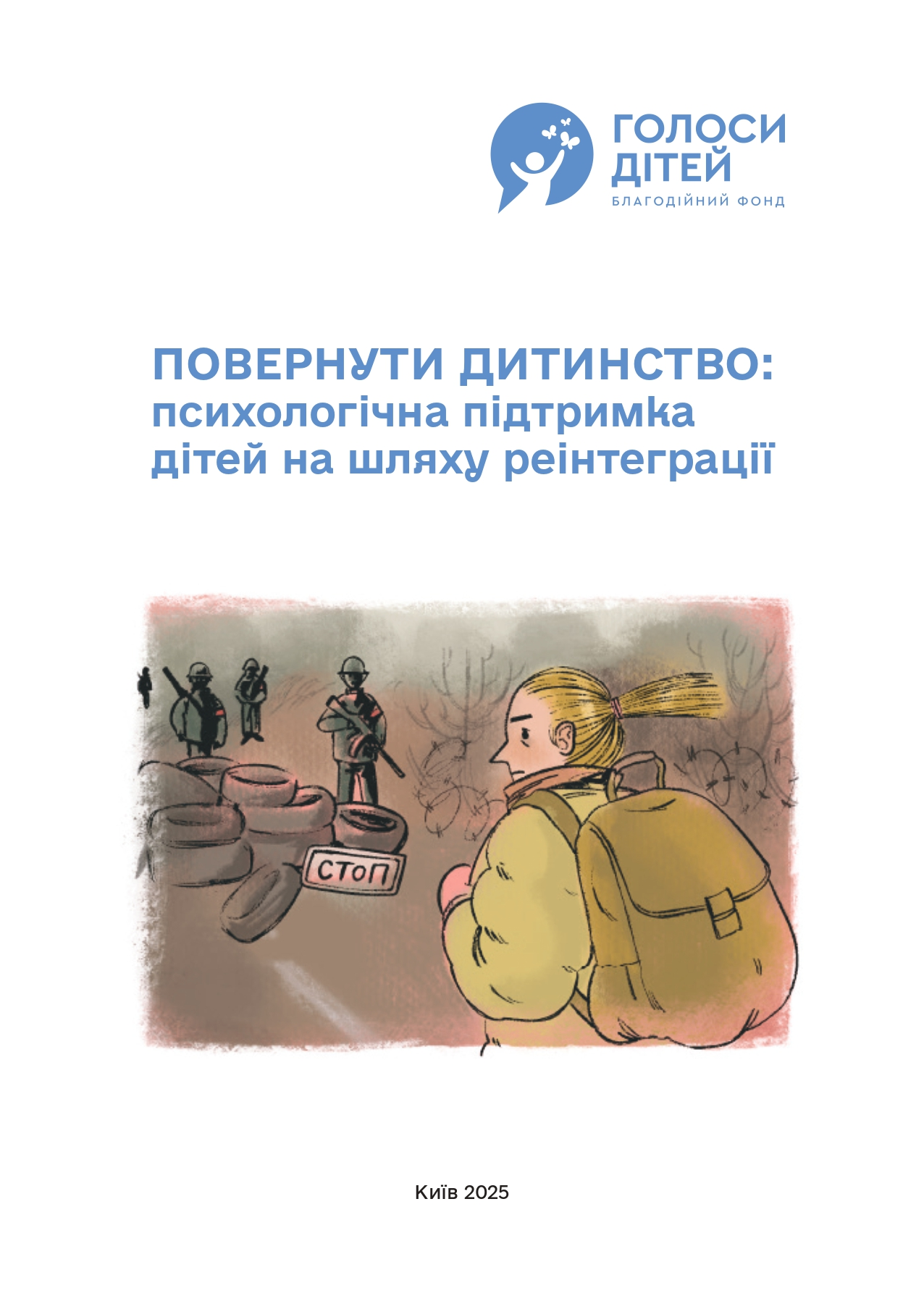
Returning Childhood: Psychological Support for Children on Their Path to Reintegration
A child’s reintegration does not end when they return home. In many ways, the hardest part begins afterward, at school, in relationships with family members, and among peers. In “Returning Childhood: Psychological Support for Children on Their Path to Reintegration,” the Voices of Children team explores what helps children recover after the traumatic experiences of war, regain a sense of safety, rebuild trust in adults, and become active members of their communities.
Beyond conducting analytical research, the Voices of Children Foundation provides psychological support to children and families affected by Russia’s invasion through individual counseling, group sessions, art therapy activities, and mobile teams working in de-occupied communities. The Foundation is also building the Childhood Center, where children and families will receive comprehensive, long-term support.
The project Strengthening Comprehensive Reintegration Support for Returning Children is implemented within the reintegration component of the President of Ukraine’s Bring Kids Back UA initiative, in partnership with the Coordination Center for the Development of Family-Based Upbringing and Child Care. It is carried out by a consortium of organizations: CSO Ukrainian Network for Children’s Rights, ICF SOS Children’s Villages Ukraine, ICF Ukrainian Foundation for Public Health, NGO League of Social Workers of Ukraine, CF Save Ukraine, and CF Voices of Children, with the support of UNICEF and funding from Canada, Norway, and the United States.
Share: