Programs & Initiatives
Assistance for Children and Parents
We respond to children's diverse needs, listen to them, and provide timely, professional help tailored to their requests.
Read more
Strengthening Communities and Children's Institutions
Together with communities and local businesses, we create inclusive spaces, playgrounds, sensory rooms, and hubs for children and teenagers.
Read more
Professional Support
We strengthen international connections and initiate our own initiatives aimed at amplifying children's voices and participation.
Read more
Advocacy
We amplify the voices of children through social campaigns, research and analytics.
 
Read more
Childhood Center
The Foundation will build a large-scale rehabilitation center for children and parents affected by the war.
Read more
Camps
Our camps are, first and foremost, psychosocial support for children — delivered as a residential program.
Read more
Eng
Ukr
All news
04.06.2026
Foundation news

(In)Accessible Support: What Prevents Children from Getting Support When They Need It

The Voices of Children Foundation, in partnership with Terre des Hommes, conducted the study "(In)Accessible Support: What Prevents Children from Getting Support When They Need It?".

The study examines how children's access to psychological and psychiatric support is regulated in Ukraine, focusing in particular on situations where children under 14 years old need support but cannot seek psychological or psychiatric care on their own without the consent of a parent or another legal guardian. In practice, obtaining such consent is not always possible due to a lack of awareness among adults, their own prejudices, or the difficult circumstances families themselves are facing.
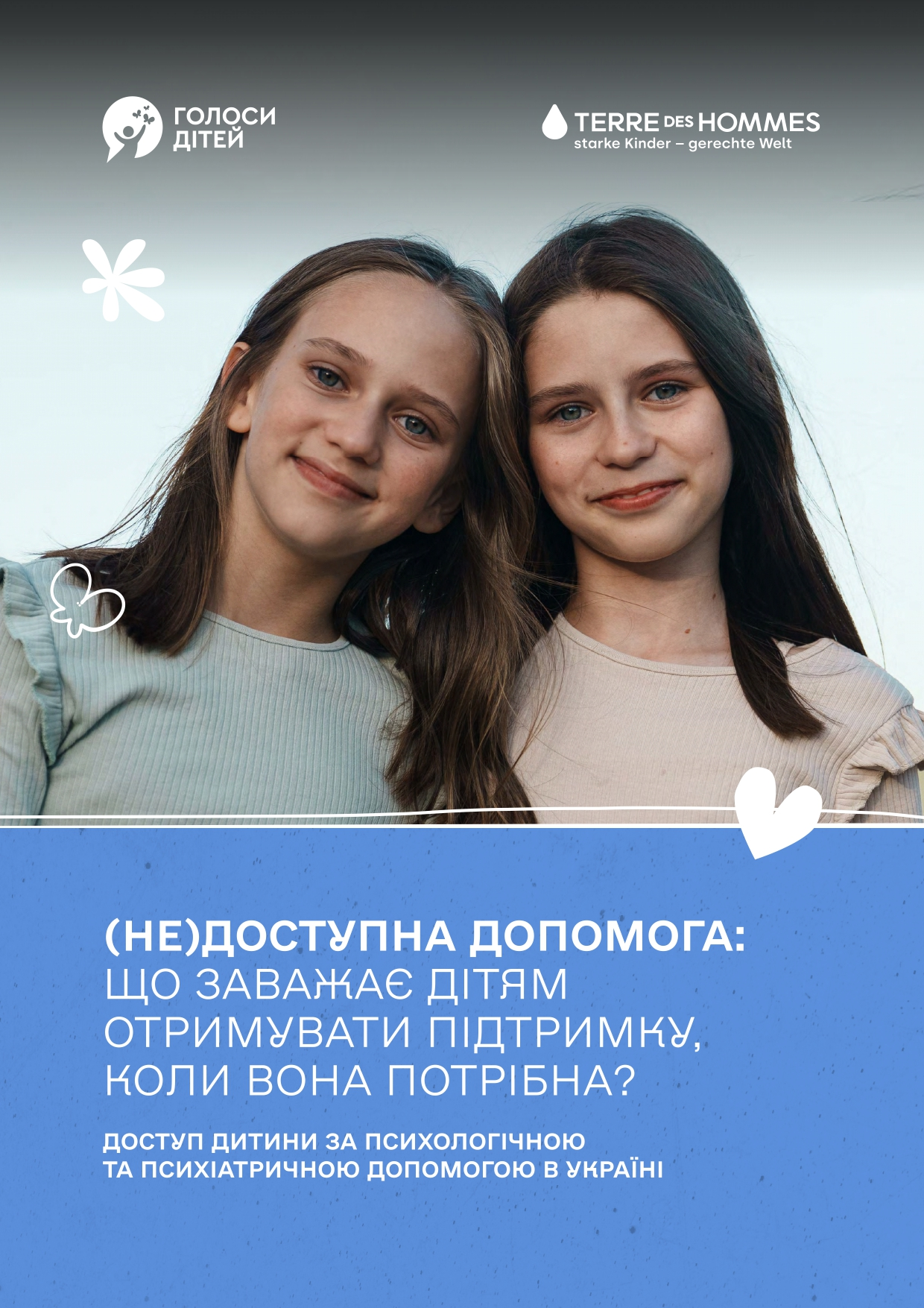
We analyzed how children's access to psychological support is regulated under international law and Ukrainian legislation. We also examined approaches used in other countries, including EU member states, the United Kingdom, Canada, the United States, and Norway. We looked at where children are allowed to seek support independently based on their age, and where access is determined through an individual assessment of the child's maturity. Drawing on this comparative analysis, we developed recommendations for making psychological and psychiatric care more accessible to children and adolescents in Ukraine, thereby safeguarding their best interests.
Download PDF
We analyzed how children's access to psychological support is regulated under international law and Ukrainian legislation. We also examined approaches used in other countries, including EU member states, the United Kingdom, Canada, the United States, and Norway. We looked at where children are allowed to seek support independently based on their age, and where access is determined through an individual assessment of the child's maturity. Drawing on this comparative analysis, we developed recommendations for making psychological and psychiatric care more accessible to children and adolescents in Ukraine, thereby safeguarding their best interests.
Download PDF
Share:
Facebook LinkedIn Twitter (X) Copy link
Latest news
What Happens to Ukrainian Children After Returning from Russian Occupation: A Voices of Children Analytical Study
Nearly 600,000 children living in temporarily occupied territories of Ukraine attend schools that have been fully converted to the Russian education system (according to the Centre for Civic Education “Almenda”). Overall, as of October 2024, around 1.6 million Ukrainian children aged 0–18 remained in temporarily occupied territories. The Voices of Children Foundation conducted the analytical study “Returning Childhood: Psychological Support for Children on Their Path to Reintegration” to better understand what families face after returning from Russian occupation.
“Artur”: A Film About a Writer Who Gave Kindness a Voice
Three years ago, Artur Dron—a poet and veteran—created an Excel spreadsheet on his computer and called it “The Literary Million.” That was the amount, in hryvnias, he dreamed of raising to support children through our Foundation. Eventually, the file had to be renamed: the number in it was growing faster than the title could keep up with the story.
“I Feel Like I’m at Home Here”: How Voices of Children Psychologists Supported Children in April and May
"I feel so good here. It feels like home!" — this is how eight-year-old Aniuta described her sessions at the Voices of Children center in Kropyvnytskyi. Over the past two spring months, there have been many moments like this across our regional centers. Children learned how to cope with stress, while parents found opportunities to pause and take care of themselves.